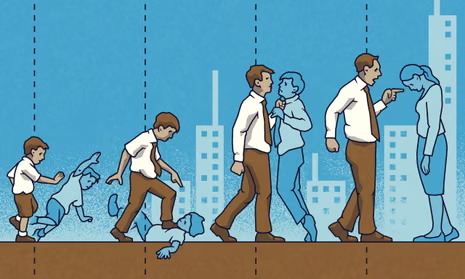
Hypnotherapy for 20 harsh truths is all about one thing.
Taking the sting out of life. This way you focus on a plan for yourself, not life’s cruelties, injustices and you never find yourself saying, “Life’s not fair!”.
You find yourself cracking on, not distracted by the things you can’t control.
It’s the kindest thing you can do for yourself.
Here we go.
1. You will die and most people won’t care after a while.
But don’t worry about other people. Let’s focus on you and your journey. Not others.
2. People will use you until you’re no longer useful.
True of relationships and - especially - the corporate world.
We can’t control how others think, feel and act, be we can work on our response. With hypnotherapy nothing NOTHING need disturb your inner peace.
3. Most people secretly want you to fail.
Don’t worry. Focus on improving not proving. Most people will start tomorrow, the day after, or at some indeterminate time in the future. You getting on annoys them, shows up their inertia, lack of drive. They want you ‘back in line’. Just like them. Talking a good game. Feeling good about doing nothing. Not getting ahead.
4. One day you’ll wish you started today.
Stop procrastinating. Or as some Yorkshire folk say stop farting around. The clock is ticking - momento mori- don’t waste time. Start now.
5. Most people fake happiness while dying inside.
Think of social media. Everyone looks maxxing living their nest life. Really?
Hypnotherapy for 20 harsh truths can turn your health other way.
6. No one is coming to save you.
The cavalry over the hill. The knight in shining armour. The death row reprieve at 11.59. It’s not happening.
And while you wait the clock ticks. You lose time. Miss opportunities. You stagnate and seethe quiet resentment. It’s everyone else’s fault. You should be acting.
What we’re saying here is that with hypnotherapy “No one is coming” becomes liberating, not bleak.
You don’t need saving you need a plan. We’ll work on one.
7. Hypnotherapy for 20 harsh truths helps you - because you’ll be judged no matter what you do.
We all watch each other. Compare. Judge.
It’s an absolute waste of time. Crack on. Do something. If it works do more of it. If it doesn’t, do something else.
Think of President Theodore Roosevelt’s quote:
8. Your health is your greatest wealth.
As the line in the Bay Luhrmann song, ‘Wear Sunscreen’ goes, “Be kind to your knees. You’ll miss them when they're gone.”
There is a mind body connection. And the more you move the better you feel. You release dopamine and oxytocin - especially if you exercise with others. Plus you boost your serotonin if you exercise outside.
And don’t put it off, start Couch to 5k tonight. Don’t wait.
I suggest to all my client to run a 5k three times a week and record on the STRAVA app.
Why? To quote Seneca, “Treat the body rigorously, so it will not be disobedient to the mind”.
For example, it’s when you put the shower on cold (you already know this!), or push yourself running. Because that is an assertion of who’s in charge. It’s when your mind tells your body who’s the boss.
Or, as Dr Seuss says, “You have brains in your head. You have feet in your shoes. You can steer yourself any direction you choose.”
9. Happiness is temporary, discipline is permanent.
There’s nothing wrong with happiness, but …
….beware. You can easily adjust to positive circumstances - pay rises, new exciting relationships, achievements - faster than we expect.
Then slowly the joy fades and your baseline reasserts itself.
So what about discipline? It compounds. Habits, once locked in, run on autopilot. If you’ve built the discipline to train, write, or save money you keep reaping returns long after the initial effort.
Why? Because motivation is unreliable. Waiting until you feel like it means waiting forever. Discipline bridges the gap between your thought and action.
So the claim becomes, “Don't chase fleeting emotional highs. Build systems that operate regardless of mood.”
And hypnotherapy helps you create this mindset. It stops the process braking down. Because discipline is also temporary - and fragile.
Burnout, injury, depression, life upheaval, or even a slow drift in priorities can erode years of your disciplined behaviour. Your habits require maintenance. They don't persist forever without reinforcement. And framing discipline as "permanent" sets up a binary where any lapse feels like total failure. Let’s not beat ourselves up.
What I’m saying here is that happiness isn't just hedonistic pleasure. The moment-to-moment positive affect, which is transient. It’s your long term well-being. Having a sense of meaning, purpose, and flourishing over time, which is far more stable.
It’s giving your discipline a direction. No direction and your discipline is simply rigidity.
Let’s make this discipline is a vehicle, not a destination. People can discipline themselves into misery - grinding away at jobs they hate, relationships that drain them, goals inherited from others. The question isn't whether to be disciplined, but disciplined toward what, and that requires revisiting what genuinely matters to you, which circles back to your well-being.
10. Success takes longer than you think.
This leads on nicely from discipline. Get ready for the long haul. And strap in for a bumpy ride. As Freddie says:
“I've paid my dues,
Time after time,
I've done my sentence,
But committed no crime,
And bad mistakes,
I've made a few,
I've had my share of sand kicked in my face,
But I've come through.”
And it’s a process you’ve got to enjoy. Overcoming the obstacles and setbacks.
11. No one respects weakness, even if they sympathise.
This is getting to understand the difference between feeling compassion for someone and seeing them as capable or admirable.
So sympathy means people may feel sorry for your pain, struggle, or vulnerability.
And respect usually comes from qualities like competence, resilience, integrity, courage, discipline, or responsibility.
Basically people can care about you while still not viewing you as strong, reliable, or influential.
For example, a person may sympathise with you if you constantly avoid responsibility because you had a difficult upbringing.
BUT they may still not respect you if you never try to improve or take ownership of your actions.
There’s also an important nuance in here.
Healthy vulnerability is not automatically “weakness.” In many situations, admitting you’re afraid, asking for help, or being emotionally honest can actually increase respect because it shows confidence and self-awareness.
What people usually lose respect for is not your vulnerability itself, but patterns like:
- Your helplessness without effort
- Your chronic excuses,
- Your lack of accountability,
- Your dependence combined with entitlement.
What people will respect you for and sympathise with is if you face difficulty with honesty, effort, and resilience.
It’s a long-winded way of saying no one likes a whinger.
12. Hypnotherapy for 20 harsh truths helps you understand complaining changes nothing.
When you blame everyone else, go on and on about your rights and feel aggrieved nothing changes.
You have to take responsibility for yourself. Overcome the injustices and figure out. Plan for yourself.
Then, also, all the rewards are yours. You’ve sorted your self out.
And like point 11 no one likes a whinger. However justified you are, however unfair, you have to channel your energies into moving on.
13. Not everyone you love will love you back.
That’s one of life’s hardest truths.
Love isn’t symmetrical.
You can deeply value someone, understand them, stay loyal to them - and still not be chosen by them in the same way.
Sometimes people care but can’t return the same intensity.
Sometimes timing, fear, priorities, attraction, or emotional limits get in the way.
And sometimes there’s no satisfying reason at all.
What makes it painful is that love feels like it should create reciprocity:
“If I see your worth so clearly, why can’t you see mine?”
But feelings are not earned like grades or rewards. Someone can appreciate you and still not love you romantically. Or love you imperfectly. Or leave.
A difficult part of maturity is realising:
- being lovable does not guarantee being loved back
- rejection happens.
Dangerously a lot of people eventually discover that longing itself can become addictive - holding onto the hope that enough patience, understanding, or sacrifice will finally change another person’s feelings.
Usually it doesn’t.
The healthier shift is often from:
“How do I make them love me?”
to:
“Why am I investing so much in someone unable or unwilling to meet me fully?”
That doesn’t remove the grief. But it restores dignity.
14. Money won’t solve all your problems - but it solves most.
There’s a reason people say this.
Money can’t fix loneliness, grief, betrayal, meaninglessness, or mortality - but it removes a huge amount of daily pressure.
Money solves:
- unstable housing
- food insecurity
- medical access
- transportation
- debt stress
- lack of time
- unsafe environments
- dependence on people you’d rather not depend on.
After basic security and reasonable freedom are met, money has diminishing returns. In fact no return in some instance if all you do is chase moire and more. People with wealth still experience:
Admittedly, money gives options, comfort, and protection. But it does not automatically give purpose, character, intimacy, or peace.
So a more accurate version might be:
Money doesn’t guarantee happiness, but lack of money reliably creates suffering.
And another uncomfortable truth is that people who say “money doesn’t matter” usually mean after they already have enough of it.
The knack is to know when you’ve got enough for what you want to do, then experience life.
Money - you can’t take it with you.
15. Social media lies to you everyday. Hypnotherapy for 20 harsh truths deals with this.
Social media doesn’t usually lie through obvious falsehoods. Its deeper distortion comes from selection.
You are shown:
- people at their most attractive
- happiest moments
- strongest opinions
- biggest achievements
- most emotional reactions
- edited identities
- simplified narratives.
Over time, that changes your sense of what is normal.
It’s ‘lying’ indirectly. It makes you see:
- Everyone else is progressing faster than you. You see highlights from hundreds of lives but compare them to your private reality.
- Wealth and success are common and effortless. Algorithms amplify extremes: luxury, beauty, fame, productivity, transformation.
- Confidence equals truth. People who sound certain often gain attention whether they are correct or not.
- Attention equals value. Viral content trains you to confuse visibility with importance.
- Outrage is the dominant public emotion. Platforms reward emotionally charged content because anger and fear increase engagement.
- Most people think in extremes. Moderate, thoughtful people are less algorithmically exciting, so online culture can look more polarised than everyday life actually is. How do you keep a sense of balance?
Social media also alters identity itself. You have to figure out what’s real in a world of curated lifestyles and moral signalling,
Remember companies like Meta Platforms, TikTok, and X Corp. are not primarily optimised for truth or wellbeing. They are optimised for engagement and retention. The more emotionally activated you are, the longer you stay.
You have to keep your critical thinking capabilities on high alert all the time and ask, “Is this helping me understand reality — or just shaping my emotions?”
16. You’re replaceable at your job.
Don’t get comfortable. In most jobs, the role is more important to the organisation than the individual person doing it.
And, yes, it’s meant to sound cold. Businesses are usually built to survive turnover. If someone leaves, retires, burns out, or is fired, the company keeps operating.
Think about it.
- companies are happy to restructure after years of loyalty
- layoffs happen despite strong performance
- someone’s workload is redistributed within days
- or a position is refilled quickly after resignation
- Your face won’t always fit.
Organisations run for continuity, cost, and function, not emotional attachment.
You have to navigate this between cynicism (“nothing matters”) and anxiety (“I must constantly prove my value”),
Remember your job is a transaction, NOT your identity. This perspective encourages you to:
- protect your health
- Have a healthier life outside work
- build transferable skills.
You have to always remember it’s a business and don’t expect the corporation to provide you unconditional loyalty.
Get a balance. Stop treating work as your sole source of worth.
17. Life is unfair. Get used to it.
You know in your heart of hearts that:
- some people are born into safety and opportunity
- others into violence, poverty, illness, or instability
- effort and reward are not perfectly connected
- good people suffer
- cruel people succeed
- ambition can beat talent.
Now the phrase “get used to it” can be taken two different ways.
One version will kill you:
“Nothing can change.It’s hopeless.”
The other version is closer to resilience:
“If you expect perfect fairness, reality will keep breaking you.”
This is what you and me and hypnotherapy works on. Accepting unfairness to reduce bitterness. You stop assuming:
- effort guarantees reward
- love guarantees loyalty
- intelligence guarantees success
- or morality guarantees protection.
That doesn’t mean you become passive. It means understanding that fairness is something people attempt to create — not something the universe automatically provides.
What we’re working on is that pain may be unavoidable. Permanent resentment is avoidable.
In other words don’t use unfairness as an excuse for defeat. Take the motivation to become more adaptable, disciplined, or compassionate with yourself.
18. One day you’ll run out of days.
To be blunt no one is getting out of here alive.
So this is a warning against postponement. Procrastination. Fannying about.
We live as if there will always be more time, so stop saying yourself:
- someday I’ll write the book
- someday I’ll apologise
- someday I’ll travel
- someday I’ll start living differently.
And think what are you currently doing:
- What habits are consuming you now without your consent?
- What relationships matter enough to protect?
- What are you tolerating because you assume there will be time later?
You see you rarely think of life as ending. You experience it as continuous. Every morning feels like the beginning of another ordinary day until eventually there are no more ordinary days left.
It’s also why the phrase memento mori (“remember you must die”) is useful. You accept reality and crack on living. You think to yourself how are you spending what is disappearing? Are your days being used deliberately or accidentally?
In other words the phrase can be less about your death than about your attention, your focus.
Not, “You will die.” But, “Given that you will die, what are you doing with today?”
19. Regret hurts more than failure.
Regret keeps rewriting itself in the imagination. It is unfinished. The mind keeps working on different endings:
- What if I had said yes?
- What if I had tried harder?
- What if I had spoken up?
- What if I had left earlier, stayed longer, taken the risk?
In other words regret preserves the question forever. It can eat you away.
Failure on the other hand gives you learnings. A chance to go again better prepared.
Ok, there’s is disappointment, embarrassment, loss, maybe even grief -but there is also clarity.
And the chance to go again.
You fail an exam - resit it.
You’re proposal rejected - turn the no into a yes.
Your business fails - go again.
All the time you’re building your experience, wisdom and resilience.
Hypnotherapy for 20 harsh truths helps you hard wire this.
It’s also why in old age people, when reflecting on life, speak less about the things they attempted and failed at, and more about the things they never attempted at all. Risks taken can be rationalised; unlived lives cannot.
Or to put it another way failure hurts the ego, regret hurts the imagination. And imagination rarely stops talking.
For me Rudyard Kipling and Theodore Roosevelt put it brilliantly.
20. Nobody cares about your excuses.
Ouch. Harsh. But true. Its power comes from an uncomfortable truth: the world responds to outcomes more than intentions.
Remember people are absorbed in their own struggles, deadlines, fears, and responsibilities. They may sympathise with your difficulties for a moment, but life keeps moving. Bills still arrive. Opportunities still pass. Time still moves forward. Because of this, explanations rarely carry the weight you hope they will.
An excuse often comes across as a validation. It says:
- “I could have succeeded if circumstances were different.”
- “It wasn’t really my fault.”
- “I had reasons.”
And, yes, sometimes your reasons are real. You may face unequal conditions, bad luck, exhaustion, trauma, poverty, illness, betrayal, and fear. Acknowledging this matters. But reality has another side: explanations do not automatically change consequences.
If an athlete loses because of poor preparation, the scoreboard does not adjust for intention.
If a student procrastinates, the deadline does not care about stress.
If someone avoids difficult conversations, relationships still deteriorate.
The brutal lesson is that life often measures execution, not your internal justification.
But the phrase becomes dangerous when misunderstood. It should not mean you:
- suppress emotion
- deny hardship
- pretend circumstances never matter
- or shame people endlessly.
And you need to understand that there is a difference between an excuse and a reason.
A reason explains your reality. It can be addressed.
An excuse explains reality so responsibility can be escaped.
This idea also reflects your maturity. As you grow older, you realise the world is not organised around fairness or emotional comfort. Responsibility becomes less about blame and more about agency. Even when circumstances are unfair, individuals still have to decide: What now?
That is why highly effective people often focus less on justification and more on adaptation. They ask:
- What can I control?
- What can I improve?
- What must be done anyway?
Excuses may temporarily protect self-esteem, but they often delay growth because they outsource power. If every failure belongs entirely to circumstances, then improvement becomes impossible. Ownership, though painful, restores your growth.
Hypnotherapy for 20 harsh truths teaches you to respect honesty about failure more than elaborate justification. When you say:
“I handled that poorly. I need to do better.”
You are stronger than someone who builds endless defences.
Your accountability signals strength. Excuses signal your fear.
What we’re working on is your discipline, consistency, and responsibility. Accept that life is unfair and that your excuses never move anything forward.
So how does hypnotherapy for 20 harsh truths work?
We all feel we’re hard wired to accept our lot, our fate. No we’re not.
As soon as you admit to any of the above harsh truths you can start to work on a plan for change.
And that’s exactly what hypnotherapy for 20 harsh truths is all about.
The mechanics are easy. You simply learn to relax. Let me ‘talk’ to your subconscious and in return you agree to change for the better.
It’s like a software upgrade for you to 2.0 thinking.
It’s you being kinder to yourself. Making more of your time on this earth. And making the best of the hand you’ve been dealt.
Hypnotherapy for 20 harsh truths. When will you start?
What we’re looking to do is stop your acceptance of what you believe is your fate, get you out of your comfort zone and into your growth zone.
And the thing about hypnotherapy is it usually does it calmly and in a relaxing way.
You get to see how easy change can be.
Come and see me in Leeds, York or Harrogate.
You can contact me at jamesthomas@thegentlemind.co.uk or call 07787563099.