What is EMDR? Is easily answered by explaining the initials, but takes a bit more unpacking to understand the meaning.
EMDR stands for Eye Movement Desensitisation and Reprocessing.
What is EMDR? The top line
EMDR is designed to help you process trauma, or other distressing life experiences.
Where can EMDR make a difference? 5 main areas
EMDR is considered a first-line treatment for PTSD by NICE (the National Institute for Health and Care Excellence), the UK body that provides recommended treatments and standards for the NHS.
1. Generally.
- Single-Event Trauma. These include accidents (car, workplace), natural disasters, or a single violent incident.
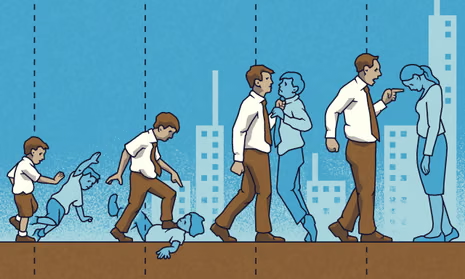
- Complex/Childhood Trauma. Chronic abuse, neglect, or prolonged bullying that leaves a person feeling "frozen in time” - they can’t move on.
- Medical Trauma: Distressing memories related to surgeries, Intensive Care Unit (ICU) stays, or diagnoses.
- Grief and Loss: Complicated grief, where the loss of a loved one, miscarriage, or divorce is not processing naturally.
EMDR targets the underlying memories that fuel anxiety disorders.
- Panic Attacks/Disorder: Reducing the frequency and intensity of panic, particularly when linked to past experiences.
- Social Anxiety/Phobia: Helping individuals feel more secure in social settings.
- Performance Anxiety: Assisting actors, athletes, and musicians in overcoming stage fright.
3. Depression and Mood Disorders
- Major Depressive Disorder: Particularly effective for depression rooted in early, negative life experiences, helping reduce rumination - the feeling of being stuck and going round and round in your thoughts.
- Postnatal Depression: Helping mothers process traumatic birthing experiences.
- Bipolar Disorder: Assisting in processing traumatic events that may trigger mood swings.
4. Addiction and Compulsive Behaviours
- Substance Use Disorders: Addressing the underlying trauma or "hidden hurts" that contribute to addiction.
- Eating Disorders: Treating anorexia, bulimia, or emotional eating by addressing the underlying trauma and negative self-beliefs.
- Obsessive-Compulsive Disorder (OCD): Used as an adjunctive treatment to reduce intrusive thoughts and compulsive actions.
5. Other Specific Challenges
- Chronic Pain/Medically Unexplained Symptoms (MUS). Some studies suggest EMDR can reduce pain sensations (e.g. phantom limb pain) by addressing the memories of the injury.
- Relationship Issues: Improving attachment and emotional regulation, reducing conflict.
- Aggression and Anger Management: Helping manage outbursts triggered by past experiences.
How it works in the brain
EMDR is based on the helping the brain when it becomes “stuck”. Basically when you’re left with, say, a trauma and you can’t get over it, you can’t move on.
This is when you’re left in a state of constant fear, or, say, mask the feelings with drink and drugs.
So during an EMDR session I will guide you through recalling a distressing memory and allowing your brain to "unblock" and re-file the memory as an ordinary, less distressing past event.
A helpful way to think about it is if talk therapy is like organising a messy filing cabinet by talking through each folder, EMDR is more like unsticking jammed files so the brain can sort them on its own.
What’s EMDR? The exact process
So you understand before we go any further here’s an exact plan of what a scion would be like. It follows what’s known as The EMDR 8-Phase Protocol.
Phase 1. What needs to be processed, and in what order?
I learn about your background. You tell me as much or as little is comfortable. What we’re looking for is the challenging memories from your past, current triggers, and future situations
Phase 2: Preparation of how we keep you safe and regulated during processing?
I’ll explain to you what is EMDR? and how it works. How you can pause or stop anytime
Phase 3: Assessment. Looking at what exactly are we targeting right now?
A specific memory is activated and broken into parts:
- We look at the worst part of the memory
- How you would define the problem e.g., “I’m powerless”
- What’s the positive thought that’s taking over? e.g., “I’m in control now”
- You rating the change. They’re called SUDs - Subjective Units of Distress from 0–10. As we proceed you rate how low we are getting
- Body sensations. How do you feel?
Phase 4: Desensitisation. Can the distress be reduced?
We start the EMDR process
- The bilateral stimulation begins (the eye movements)
- You notice whatever comes up—thoughts, images, emotions, body sensations
- I check in briefly: “What do you notice now?”
- We keep processing until we drop the SUD to 0 or near 0.
Phase 5: Installation. Has a healthier belief replaced the old one?
- Focus shifts to strengthening the positive cognition
- Bilateral stimulation continues while pairing it with the memory
- Goal: increase the positive feeling.
Phase 6: A body scan. Is the trauma still stored in the body?
- Together we mentally scan your body while thinking of the memory a positive thought
- Any residual tension or discomfort is processed with BLS
Phase 7: Closing. Are you calm enough to leave the session?
- The session is safely wrapped up.
- We work on your calmness before leaving
- Your ‘homework’ may include noticing changes or using coping tools
Phase 8: Re-evaluation. Did the work hold, and what’s next?
- At the next session, I check to see if the memory stayed neutral? If the triggers reduced? Is there another issue to deal with?
- Basically you and me are deciding whether to reprocess further or move on to another issue.
The key benefits
- Speed: Many patients experience a significant relief in fewer sessions (often 6–12) compared to traditional talking therapies.
- Less Talking: Unlike a standard therapy, EMDR does not require you to describe the traumatic event in great detail, or complete homework between sessions. You can take yourself into the scene and deal with it. Explaining can sometimes bring everything back all too painfully
- Versatility: While EMDR is best known for PTSD, it is also used for anxiety, depression, phobias, grief, and chronic pain.
What triggers the eye movements in EMDR?
Simple answer? I do. I guide you to follow my finger back and forth.
This action, often referred to as bilateral stimulation (BLS).
You keep your head still while I direct you to move your eyes from side to side.
It’s these movements that help "unstick" traumatic memories, allowing the brain to process them and reduce your anxiety.
What's the difference between EMDR and other trauma therapies like CBT?
How does EMDR help with things like anxiety or depression?
What EMDR isn’t
Another way of looking at what is EMDR? Is to explain what it isn’t.
It’s NOT mind control or brainwashing. It only works if you want it to work. It’s up t me to build trust between us both so you believe in the process
It’s NOT memory erasure. You don’t forget what happened. We’re making it easier for you to live with events and memories so you’re less troubled.
It’s NOT just “waving fingers”. The eye movements are part of the structured, 8-phase protocol I described earlier.
It’s NOT instant or effortless (it can be emotionally intense and requires preparation)
It’s NOT only for trauma. It’s also used for chronic stress, childhood experiences and attachment wounds
What does it feel like?
It feels different for everyone, but there are some common themes.
During a session your mind may start jumping around on its own—images, thoughts, emotions, body sensations, even random memories you didn’t expect.
Some people describe it can feel a bit like daydreaming, but intense, or like your brain is “sorting files” without you consciously directing it.
Whereas some people talk about waves of emotion (sadness, fear, anger, relief) combined with physical sensations (tight chest, warmth, tingling, heaviness, yawning).
To others there’s a sense of distance from the memory—like watching it on a screen instead of being inside it
You’re usually still aware of the room and your therapist. You’re not out of control.
Quite often people say things like, “I know it happened, but it doesn’t feel like it’s happening to me anymore.”
That emotional shift is one of the goals of EMDR.
Over time when EMDR works well, people notice:
- Triggers don’t hit as hard or as fast
- The memory feels more like a fact than a wound
- You have less body reaction (panic, shutdown, tension)
- More ‘feel’ you’ve more space to choose how to respond
On the other hand what it doesn’t feel like is that you don’t relive everything in graphic detail the whole time. You also notice that you’re not forced to talk if you can’t find words: it’s not a constant emotional flooding.
Does it Really Work?
The short answer: yes—EMDR really does work for a lot of people, especially for trauma.A longer, more honest answer is it’s effective, well-supported by research.
IT’S NOT MAGIC AND IT’S NOT UNIVERSAL.
Although there is strong evidence for its use to give PTSD less meaning (combat trauma, sexual assault, accidents, childhood trauma). And is endorsed by organisations like the World Health Organisation, the American Psychological Association and the U.S. Department of Veterans Affairs.
How Long Does EMDR Take?
It depends, but there are useful ballpark ranges.
- For a single-incident trauma possibly 6–12 sessions
- Multiple or complex trauma: months, sometimes a year or more.
There may be a need for some preparation first. Often 2 – 6 sessions before actual reprocessing starts
EMDR isn’t usually “one session and done,” but it also isn’t endless for most people.
What affects how long it takes? A few big factors make a real difference:
- The type of trauma
- One clear event (accident, assault, medical trauma) = usually faster
- Repeated or developmental trauma = slower, more layered
- How stable you’re feeling right now
-
- If you’re safe, supported, and regulated enough the whole process maybe faster
- If life is chaotic or emotions overwhelm you easily we need more preparation time.
- Are we targeting one core memory or many interconnected ones?
-
- Sometimes clearing one “root” memory softens a whole cluster
- Your nervous system and personality
-
- Some people process quickly, others need a slower pace so it doesn’t feel overwhelming. Let’s not rush.
It’s rarely reprocess → done → goodbye
More often it’s a process of preparation, reprocessing a memory over several sessions, checking whether the triggers have actually changed in real life, then moving to the next target (if needed)
Realistically we’ll start, see how your system responds and adjust accordingly.
What to expect after a session
After an EMDR session, people often say, “Okay… that was more than I expected,” or “That was weirdly subtle.”
Both are normal.
Here’s what you can realistically expect—right after, later that day, and over the next few days.
Immediately after a session you might feel tired or drained (very common), or surprisingly calm, light, or neutral
Some people feel grounded and clear; others need quiet. Neither means it “worked” or didn’t—just that your nervous system did real work.
Later that day it’s common to notice emotional waves that come and go and body sensations such as heaviness, warmth, tightness, or a sense of release
For some there’s a need to rest, nap, or be alone
Don’t worry if raw emotions show up: your brain is still processing.
Over the next 1–3 days
This is where people get curious (or anxious).
You might notice:
- Dreams (sometimes vivid, sometimes symbolic)
- Memories popping up briefly, then fading
- New perspectives like “That wasn’t my fault” landing emotionally, not just intellectually
- Temporary emotional sensitivity
Occasionally people feel worse before better for a short window. This should feel manageable, not overwhelming—if it’s intense or lasts, that’s something to tell your therapist.
It’s also worth flagging to me if:
- You feeling ‘flooded’ or destabilised
- You feel strong urges to avoid sessions. It’s okay. We can take things slower. Basically good EMDR is at a pace that works for you pacing - suffering isn’t the goal.
- Your distress that doesn’t ease after a few days
- You have trouble functioning in daily life
In effect, there may be no magic moment. A “quiet” session can still be effective. A “hard” session doesn’t mean harm. Progress often shows up as less intensity, more distance, more choice.
Is EMDR Safe?
Generally, yes.
Why?
As I mentioned before it’s evidence-based and backed by decades of research.
It’s non-invasive. There’s no medication, no hypnosis, and you remain fully conscious and in control.
Also I follow a structure designed to keep clients grounded and safe.
That’s not to say there aren’t possible side effects - usually temporary - that aren’t dangerous), but they can feel uncomfortable. These include:
- Strong emotions during or after sessions
- Fatigue, vivid dreams, or emotional sensitivity for a day or two
- Old memories or feelings surfacing between sessions
When EMDR Might Not Be the Right Fit
Certain underlying conditions mean EMDR might not be right for you. These include:
- Dissociative Identity Disorder (DID)
- You’re currently experiencing abuse or violence
- You’re actively suicidal
- You’re in an acute crisis or severe instability
- You’re taking drugs
- You have bipolar disorder
- Active psychosis
- Severe untreated depression.
Common Myths About EMDR
To be clear. When answering the question what is EMDR? There are somethings is definitely isn’t.
It isn’t magic, mind control, or a torture test. It’s a structured way of helping the brain heal. Like any therapy, it works best when it’s the right tool at the right time with the right person.
Here’s what it ISN’T
(1). It isn’t mind control. You’re fully awake, aware, and in control the entire time.
You can stop, slow down, or redirect at any point. No one is “putting ideas in your head.”
(2). You DON’T have to relive your trauma in detail. You don’t need to describe everything out loud or re-experience it vividly. Many people share far less detail than in traditional talk therapy.
(3). It DOESN’T have to be too intense or re-traumatising. Take it easy. Dictate the pace.
(4). It DOES MORE than work for PTSD. EMDR is used for much more, including:
- Anxiety and panic
- Phobias
- Grief
- Chronic pain
- Attachment wounds
- Performance blocks
And, remember, trauma isn’t always about one big event.
(5). It’s NOT a quick fix that cures everything”. It can be fast for some people, but everyones journey is different.
To sum up EMDR isn’t magic, mind control, or a torture test—it’s a structured way of helping the brain heal. Like any therapy, it works best when it’s the right tool at the right time with the right person.
Preparing yourself for EMDR
It might be painful, but the more honest you can be with your therapist the better things will be. You can take your time and open up slowly at every session.
I’m particularly wanting to hear about
- Dissociation or “numbing out”
- Panic attacks
- Substance/alcohol use to mask a pain
- Sleep issues or nightmares
- What feels overwhelming versus tolerable
This helps me pace things safely - not push you.
Also manage yourself. EMDR isn’t always neat or linear, or an instant erasure of memories. More often it’s subtle at first followed by emotional shifts. It’s more about reducing distress than “forgetting”
Healing is not linear
I need you to understand that nothing is “wrong” with you when it feels messy, slow, or contradictory. That’s real life.
For example, you might:
- Feel lighter for weeks then suddenly heavy again
- Think you’re “done” with something and get triggered out of nowhere
Why? It’s because you’re human, not a machine. Most people who EMDR are being brave.
You also need to understand that setbacks aren’t failures. What may look like a setback is often:
- Your nervous system processing a deeper layer
- Old patterns flaring up before losing their grip
- Growth happening faster than your sense of safety can keep up with. It makes you feel uncertain.
Healing often circles back, but each loop usually has less intensity or more awareness. This is your brain healing in stages, especially with trauma work.
Another way of thinking of this is it’s you asking yourself, “Is it safe now?” That’s your brain doing its job - not sabotaging you. We can expect expect a steady improvement, only to disappoint ourselves by thinking, “I should be past this by now.” But healing isn’t about being “past” something—it’s about being less controlled by it.
So instead of asking yourself, “Why am I struggling again?” A gentler re-frame would be:
“What is this part of me asking for right now?”
Or:
“What’s different this time, even if it hurts?”
Often the difference is capacity—you’re feeling more because you can.
This is the quiet truth of the process. If you’re noticing patterns, questioning old beliefs, or responding differently—even on hard days—you are healing. It just doesn’t announce itself with a straight upward arrow.
Another ay of looking at things is to think of it like this - you’re not behind. You’re in it.
My take on EMDR - EMDR and hypnotherapy
I combine EMDR with hypnotherapy. Why? Clinical hypnosis guides you into a deeply focused, relaxed state where you can make memories, emotions, and body sensations more accessible. You’re not unconscious or controlled - you’re aware and can stop anytime
So, combing EMDR with hypnosis can help you relax faster to create a sense of calm and confidence before EMDR processing.
If you’d like to chat please feel free to call me on 0778756 3099 or email me at jamesthomas@thegentlemind.co.uk
I appreciate that you might have been through a lot, so if you like to know more about me, The Gentle Mind, have a read here.