Hypnotherapy for dealing with narcissists is usually after the event. Once you're out of the relationship and we deal with the lasting harm that's been done.
‘Narcissist’ is a word you hear bandied around. Usually to refer to someone who’s a ‘bit of a big head’ or ‘pompous’.
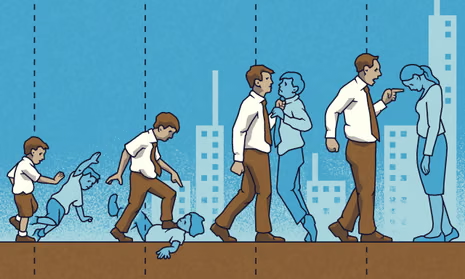
But a true narcissist can do serious lasting damage to others.
Narcissistic personality disorder is a mental health condition giving people an unreasonably high sense of their own importance.
They need and seek too much attention and want people to admire them. People with this disorder may lack the ability to understand, or care, about the feelings of others.
At the core, they are not sure of their self-worth and are easily upset by the slightest criticism.
In return, they can make your life a living hell.
They appear in your life at various stages most notably school, work or relationships.
Spotting the signs of narcissism
Look out for the following:
- They have an unreasonably high sense of their own self-importance and need constant, excessive admiration.
- Feel that they deserve privileges and special treatment.
- Expect to be recognised as ‘better’ regardless of their achievements.
- A constant preoccupation with fantasies about success, power, brilliance, beauty or the perfect mate.
- They’ll be critical of you and look down on people they feel are not important - belittle their achievements.
- Expect special favours and expect other people to do what they want without questioning them.
- Take advantage of others to get what they want.
- Have an inability or unwillingness to recognise the needs and feelings of others.
- Be envious of others and believe others envy them.
- Behave in an arrogant way, brag a lot and come across as conceited.
- Insist on having the best of everything — for instance, the best car or office.
- Talks bad about friends and family when they aren’t around.
- Blames others for their own problems and failures.
- Acts differently when with others compared to when alone.
- Doesn’t keep promises and can’t be trusted.
- Thinks they are better than the people close to them.
- Imagines a perfect life, which may include porn, flirting, cheating, and wanting to be famous.
- Can’t stop thinking about these fantasies.
- Lies and changes the truth to make themselves look good.
- Doesn’t handle money well.
- Doesn’t show feelings or care about others unless they need something.
- Feels no sympathy for people they take advantage of.
- Likes to be in control and can’t relax.
- Often starts arguments and then blames others.
- Has a hard time saying they’re wrong.
- Claims to have had a bad/abusive childhood. 'Pity me'.
- Has a mother enabler.
How narcissists reveal themselves
The most obvious signs appear when they are criticised or feel they are being criticised. They usually can’t handle this and you get a chance to look behind the mask.
They can:
- Become impatient or angry when they don't receive special recognition or treatment.
- Have major problems interacting with others and easily feel slighted, or constantly want to be the centre of attention.
- React with rage or contempt and try to belittle other people to make themselves appear superior.
- Have difficulty managing their emotions and behaviour.
- Experience major problems dealing with stress and adapting to change.
- Withdraw from, or avoid, situations in which they might fail.
- Feel depressed and moody because they fall short of perfection.
- Have secret feelings of insecurity, shame, humiliation and fear of being exposed as a failure.
Where narcissists can really damage you - in relationships
When you’re in the thick of it - usually when you’re deeply in love - that’s when narcissists can really go to work and create mayhem.
Narcissists can be controlling and intolerant while refusing to acknowledge wrongdoings.
They'll use an array of manipulative strategies to escape blame and perpetuate abuse. Sometimes, they'll "gaslight" you into questioning your own feelings. Or they'll use "baiting" to purposefully provoke you when you want to be left alone. Even after the relationship ends, the emotional abuse can continue with tactics like "hoovering."
Explained: The phrases associated with Narcissists
Love bombing
Even the most abusive relationships can start off like a fairytale with lavish gifts, extravagant getaways and public displays of affection but this initial phase, cycled with abuse, is an emotional manipulation tactic known as love bombing. It’s a case of too much too fast.
And so it continues. The true difference between an exciting start to a blossoming romance and love bombing is what happens as the relationship progresses.
If this is ‘love at first sight’, you’ll be accepted when you get more comfortable and expose the annoying and unattractive parts of yourself. With love bombing this is never the case.
Instead, they may lose total interest in you and disappear leaving you completely confused. Or, in some instances, they may drip-feed little romantic gestures along with opposite gestures like criticism. What going on here is that the narcissist is using a deeper motivation to hook you into something and manipulate the relationship to benefit their own needs.
Gaslighting
You feel you’re questioning your sanity. Your memories, or sense of reality.
Gaslighting doesn’t just happen in relation to big events, it can occur over little things as a way to plant self-doubt and shift the power dynamic.
Some examples include:
- Lying about or denying something - even when you show them proof.
- Insisting that an event never happened; that you’re remembering it wrong.
- Changing the subject or refusing to listen when confronted them.
- Telling you that you’re overreacting when you call them out.
Basically, elaborate lying.
Baiting
When a narcissist isn't getting the attention they want from victims, they can deliberately provoke or trigger them by "baiting."
They may, for instance, insult somebody they know you care about or make inflammatory, false accusations about you.
Other examples of baiting include:
- Overt insults such as mocking, taunting and ridiculing with offensive jibes.
- Guilt-tripping, playing the victim, blaming others for their own unhappiness, to get a response.
- Intimidation and threats to provoke fear or anxiety in order to keep you compliant, for instance, they may threaten to publicly expose secrets, vulnerabilities or insecurities.
Hoovering
This is when a toxic ex tries to reenter your life under the disguise of change. They'll say they've grown into a more loving partner - even offer up tempting gifts. But do they mean it?
This is a narcissist using "hoovering". Sucking you back in through manipulation and lies – only to continue the cycle of abuse.
Someone who has actually changed will acknowledge the hurt they've caused or take behavioural steps like therapy. Instead, a hooverer will say something like, 'Baby, if you take me back, we're going to buy that house' or 'I won't work at the bar anymore if we get back together.' So the coming back becomes enticing because it offers things they know the person wants.
More signs. Narcissists NEVER do these four things.
1. They never give compliments.
One of the first things you’ll notice about narcissists is that they rarely give compliments.. If it seems like they did, look closely, you’ll often find that the compliment was given to benefit them in some way. They don’t give sincere compliments because they don't want other people to feel good about themselves. Instead they withhold genuine praise and will often brag about themselves instead. Their goal is to keep the spotlight on them, not you.
2. They never apologise.
Even if you catch them red-handed with clear proof they did something wrong, they will still refuse to say sorry, Why? Because apologising means taking responsibility and narcissists will avoid accountability at all costs. In fact instead of apologising, they’ll often twist the situation around and blame you for what they did. This is one of their most confusing tactics because most people think “i would never do that, so surely they wouldn’t either,” that’s how many people end up believing the narcissist’s false version of reality (see 'Gaslighting').
3. They will never give up control.
Control is also everything to a narcissist. They want to make you believe you can’t do anything without them. If you try to prove them wrong, they will try to make you fail. This is why divorcing a narcissist or dealing with custody battles can drag on for years, they don't care about the damage it causes you—or even their own children. In fact some narcissists go so far as to create lies or even fake evidence just to paint you as the problem. You see, their goal is always the same - to keep control and make their version of reality win.
4. Helping someone anonymously - never.
You’ll also never see a narcissist do something good in secret. If they donate money, help someone or do a kind act, they’ll want recognition for it. They don't do good deeds just to help others, they do them to polish their image and make themselves look good in public. That way, if anyone tries to expose their abusive behaviour, people might not believe it because “how could such a generous person do something so awful?” Thye make their own PR.
At the heart of It, everything a narcissist does is for themselves. They don't see others as equals, they need to feel like they are the most important, the most successful and the most admired person in the room. You won't see them surround themselves with people who are more successful, wealthier, smarter or better-looking because being around someone “superior” makes them feel small and jealous.
Why? Because for a narcissist, nothing is worse than being outshined. Their whole life is built around avoiding that feeling, even if it means tearing others down just to feel on top.
How Cognitive Behavioural Therapy and Hypnosis helps you deal with Narcissists
Unfortunately, it’s usually after the event that I see people who have had to live with a narcissist.
Sometimes people can recognise the signs and my advice is to get out.
To get a narcissist to change is extremely hard - and draining for you.
Typically after the event you find you’re:
- Exhausted
- Lost your confidence
- Lost your belief
- Find it hard to trust others/new partners
- Feel you’ve been made a fool.
But we can turn things around. We can work together to take away the meaning and attached feelings so all you’re left with is the experience and learnings. And a better tuning to your emotional radar.
The hurt, self-doubt and feeling of all that time wasted can be dialled down. Sometimes to zero.
We can neutralise the hurt, give you your mojo back and get you ready to trust and love again.
Who am I?
I’m James Thomas a Cognitive Behavioural Hypnotherapist. I’ve used hypnosis thousands of times to deal with clients’ stresses, anxieties, drug addiction, alcohol abuse, PTSD, overeating, low self-esteem, eczema, and anger, to name but a few.
And to help people, usually women, recover from the harm of a narcissist. It takes time, but we can get there.
Hypnotherapy for dealing with narcissists is usually in two parts. The healing of the past and helping you recognise the signs in any future relationships - it's easier when you're calm.
I cover Yorkshire with my rooms in Leeds, Harrogate and York.
Get in touch with me at jamesthomas@thegentlemind.co.uk or call 07787563099.
Let’s take the learnings and put these things in the past.
Hypnotherapy for dealing with narcissists other steps you need to take
More often that not narcissists have a track record. You won't be the first and you won't be the last.
It's well worth contacting IDAS - Independent Domestic Abuse Service - for help.
And using Clare's Law, formally known as the Domestic Violence Disclosure Scheme (DVDS). This gives you the legal right to ask the police if a current or ex-partner has a history of domestic abuse or violent behaviour.
- The Right to Ask: You can formally request information from the police if you are worried a partner—or the partner of a family member, friend, or neighbor—may pose a risk.
- The Right to Know: The police can proactively disclose information about a person's abusive past without a request if they believe someone is at high risk of harm.
- Apply online through your local police force's website
- Call 101 (the non-emergency police number) or visit a local police station.
- If you or someone else is in immediate danger, always call 999.